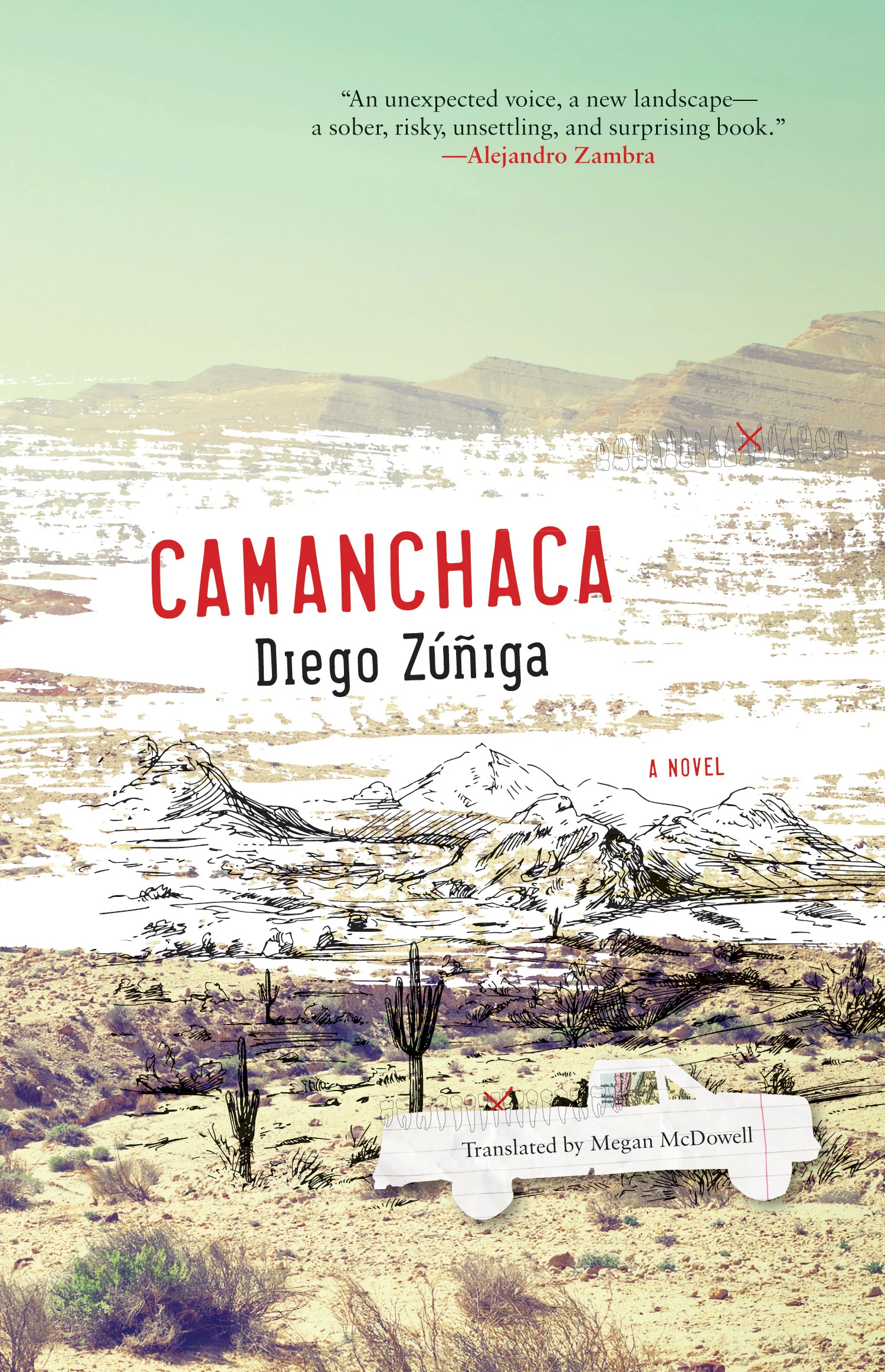
Camanchaca
A novel by Diego Zúñiga, translated by Megan McDowell
March 7, 2017 • 5 x 7.75 • 128 Pages • 978-1-56689-460-9
On a long, near-silent drive with his father, a young man surveys the “worn-out puzzle” of his broken family.
A long drive across Chile’s Atacama desert, traversing “the worn-out puzzle” of a broken family—a young man’s corrosive intimacy with his mother, the obtrusive cheer of his absentee father, his uncle’s unexplained death. Camanchaca is a low fog pushing in from the sea, its moisture sustaining near-barren landscape. Sometimes, the silences are what bind us.
About the Author
Diego Zúñiga (born 1987) is a Chilean author and journalist. He is the author of two novels and the recipient of the Juegos Literarios Gabriela Mistral and the Chilean National Book and Reading Council Award. He lives in Santiago de Chile.
Megan McDowell is a Spanish language literary translator from Kentucky. Her work includes books by Alejandro Zambra, Arturo Fontaine, Lina Meruane, Mariana Enriquez, Álvaro Bisama, and Juan Emar. Her translations have been published in the New Yorker, the Paris Review, Tin House, McSweeney’s, Words Without Borders, Mandorla, and Vice, among others. She lives in Santiago, Chile.
Thanks to a 2013 ADA Access Improvement Grant administered by VSA Minnesota for the Metropolitan Regional Arts Council, this title is also formatted for screen readers which make text accessible to the blind and visually impaired. To purchase this title for use with a screen reader please call (612) 338-0125 or email us at info@coffeehousepress.org.
Reviews
“This arresting and deeply affecting read, despite its short length, packs a punch.” —Publishers Weekly
“Deftly written, there is much to admire on the page.” —Fanzine
“It’s precisely this coolly observant language, deepening with the story, that lets us register the buried despair.” —Library Journal
“A smart, straightforward narrative that reveals the varied mood a shared experience can evoke.” —Kirkus Reviews
“The simple, elegant narrative braiding—a paternal recto, a maternal verso—serves as both metaphor for a boy who is of two minds about everything and as a driveshaft, propelling the reader to a too-soon ending in a state of horror bordering on awe.” —The Rumpus, “HORN!” review
“Camanchaca has one of the strongest novel openings I’ve read in years, a knockout vignette that disarms the reader with a few beats of unnecessarily specific detail, and then seamlessly shifts into fast and steady motion while glancing across a violent mystery all in just a quarter of a page.” —Electric Literature
“This slim book promises emotional and intellectual challenges for the intrepid reader.” —Booklist Online
“Among this novel’s many merits (which go far beyond the stylistic), Zúñiga has achieved something more: he has depicted, with astonishing perfection, the mediocrity of the Chilean middle class, its simplicity and its emptiness: characters who barely communicate and pass their time watching TV, sleeping, and eating sandwiches wherever they may be; half-brothers who hardly know each other and look at each other with jealousy; families whose only epic, at the end of the day, is an attempt to buy brand-name clothes and take care of a dying dog.” —World Literature Today
“The novel is episodic, swinging from the past to the present, with no bit lasting longer than a page. The effect is poetic, and Zúñiga’s bare sentences also resemble the Atacama.” —Colorado Review
“Camanchaca is a riddle, a mind game, sometimes maddening but always compelling.” —Star Tribune
“The tidy parcels pack jolts of emotion as Zúñiga discloses the foundation of the burdens the young narrator has carried through his life, every page another piece of the sad, damaged puzzle. As powerful as it is spare, Camanchaca is a raw trip through an emotional wasteland.” —Shelf Awareness
“The simple, straightforward prose flies across the dry pages exactly as if Zúñiga were driving you across the desert himself.” —Atticus Review
“Camanchaca . . . succeeds at combining the particularity of its setting with scenarios that feel almost classical: a murdered brother and the perversion of the mother-son relationship. But it also dramatizes the struggle to understand the previous generation, whether the truth sought is that of family or country.” —BOMB
“An unexpected voice, a new landscape—a sober, risky, unsettling and surprising book.” —Alejandro Zambra
“The amiable placidity of Camanchaca’s young narrator attests to a safeguarding remoteness that cannot quite suppress a terrible mounting compulsion to confront his family’s past and be released from its burden of secrets. Diligent but lacking the capacity to form judgments, distressed yet detached, I don’t think I’ve come across a more evocative depiction of the painstaking transition from adolescence into the adult world.” —Claire-Louise Bennett
“Diego Zúñiga is the author of an extraordinary first novel. Camanchaca is written with austerity and a laconic and fragmented style that is like the shreds through which we are able to catch glimpses of the landscape through the fog.” —Patricio Pron
“Nothing is stated outright in Camanchaca, everything is sounded out, intuited, like silhouettes or protrusions whose contours jut out just barely through cloth. . . . [Zúñiga] veils an entire way of life, a kind of underwater ‘ethos’ in which there nests an invisible substructure of violence, abuse, and desolation.” —Pablo Torche, Letras en línea
“A sparse, innovative and heartrending study of a broken family. . . . A debut novella that is quite stunning in its compact emotional heft.” —Brazos Bookstore
“A thoughtful, even meditative, story of a young man for whom the problems of his parents, the problems of the adult world that he is approaching, are still just beyond his understanding.” —Josh Cook, Porter Square Books
“The past converges with the present in this startling debut by Diego Zúñiga. A young man, uncertain in life, penetrates his family’s dysfunctional past during a road trip across the Chilean desert. Taut and fragmented, brilliant and brave, Camanchaca perfectly captures the difficult transition from young man to adult. A small diamond of a novel that once again proves literature can break your heart and infuse the spirit at the same time.” —Mark Haber, Brazos Bookstore
A novel by Diego Zúñiga, translated by Megan McDowell
March 7, 2017 • 5 x 7.75 • 128 Pages • 978-1-56689-460-9
On a long, near-silent drive with his father, a young man surveys the “worn-out puzzle” of his broken family.
A long drive across Chile’s Atacama desert, traversing “the worn-out puzzle” of a broken family—a young man’s corrosive intimacy with his mother, the obtrusive cheer of his absentee father, his uncle’s unexplained death. Camanchaca is a low fog pushing in from the sea, its moisture sustaining near-barren landscape. Sometimes, the silences are what bind us.
About the Author
Diego Zúñiga (born 1987) is a Chilean author and journalist. He is the author of two novels and the recipient of the Juegos Literarios Gabriela Mistral and the Chilean National Book and Reading Council Award. He lives in Santiago de Chile.
Megan McDowell is a Spanish language literary translator from Kentucky. Her work includes books by Alejandro Zambra, Arturo Fontaine, Lina Meruane, Mariana Enriquez, Álvaro Bisama, and Juan Emar. Her translations have been published in the New Yorker, the Paris Review, Tin House, McSweeney’s, Words Without Borders, Mandorla, and Vice, among others. She lives in Santiago, Chile.
Thanks to a 2013 ADA Access Improvement Grant administered by VSA Minnesota for the Metropolitan Regional Arts Council, this title is also formatted for screen readers which make text accessible to the blind and visually impaired. To purchase this title for use with a screen reader please call (612) 338-0125 or email us at info@coffeehousepress.org.
Reviews
“This arresting and deeply affecting read, despite its short length, packs a punch.” —Publishers Weekly
“Deftly written, there is much to admire on the page.” —Fanzine
“It’s precisely this coolly observant language, deepening with the story, that lets us register the buried despair.” —Library Journal
“A smart, straightforward narrative that reveals the varied mood a shared experience can evoke.” —Kirkus Reviews
“The simple, elegant narrative braiding—a paternal recto, a maternal verso—serves as both metaphor for a boy who is of two minds about everything and as a driveshaft, propelling the reader to a too-soon ending in a state of horror bordering on awe.” —The Rumpus, “HORN!” review
“Camanchaca has one of the strongest novel openings I’ve read in years, a knockout vignette that disarms the reader with a few beats of unnecessarily specific detail, and then seamlessly shifts into fast and steady motion while glancing across a violent mystery all in just a quarter of a page.” —Electric Literature
“This slim book promises emotional and intellectual challenges for the intrepid reader.” —Booklist Online
“Among this novel’s many merits (which go far beyond the stylistic), Zúñiga has achieved something more: he has depicted, with astonishing perfection, the mediocrity of the Chilean middle class, its simplicity and its emptiness: characters who barely communicate and pass their time watching TV, sleeping, and eating sandwiches wherever they may be; half-brothers who hardly know each other and look at each other with jealousy; families whose only epic, at the end of the day, is an attempt to buy brand-name clothes and take care of a dying dog.” —World Literature Today
“The novel is episodic, swinging from the past to the present, with no bit lasting longer than a page. The effect is poetic, and Zúñiga’s bare sentences also resemble the Atacama.” —Colorado Review
“Camanchaca is a riddle, a mind game, sometimes maddening but always compelling.” —Star Tribune
“The tidy parcels pack jolts of emotion as Zúñiga discloses the foundation of the burdens the young narrator has carried through his life, every page another piece of the sad, damaged puzzle. As powerful as it is spare, Camanchaca is a raw trip through an emotional wasteland.” —Shelf Awareness
“The simple, straightforward prose flies across the dry pages exactly as if Zúñiga were driving you across the desert himself.” —Atticus Review
“Camanchaca . . . succeeds at combining the particularity of its setting with scenarios that feel almost classical: a murdered brother and the perversion of the mother-son relationship. But it also dramatizes the struggle to understand the previous generation, whether the truth sought is that of family or country.” —BOMB
“An unexpected voice, a new landscape—a sober, risky, unsettling and surprising book.” —Alejandro Zambra
“The amiable placidity of Camanchaca’s young narrator attests to a safeguarding remoteness that cannot quite suppress a terrible mounting compulsion to confront his family’s past and be released from its burden of secrets. Diligent but lacking the capacity to form judgments, distressed yet detached, I don’t think I’ve come across a more evocative depiction of the painstaking transition from adolescence into the adult world.” —Claire-Louise Bennett
“Diego Zúñiga is the author of an extraordinary first novel. Camanchaca is written with austerity and a laconic and fragmented style that is like the shreds through which we are able to catch glimpses of the landscape through the fog.” —Patricio Pron
“Nothing is stated outright in Camanchaca, everything is sounded out, intuited, like silhouettes or protrusions whose contours jut out just barely through cloth. . . . [Zúñiga] veils an entire way of life, a kind of underwater ‘ethos’ in which there nests an invisible substructure of violence, abuse, and desolation.” —Pablo Torche, Letras en línea
“A sparse, innovative and heartrending study of a broken family. . . . A debut novella that is quite stunning in its compact emotional heft.” —Brazos Bookstore
“A thoughtful, even meditative, story of a young man for whom the problems of his parents, the problems of the adult world that he is approaching, are still just beyond his understanding.” —Josh Cook, Porter Square Books
“The past converges with the present in this startling debut by Diego Zúñiga. A young man, uncertain in life, penetrates his family’s dysfunctional past during a road trip across the Chilean desert. Taut and fragmented, brilliant and brave, Camanchaca perfectly captures the difficult transition from young man to adult. A small diamond of a novel that once again proves literature can break your heart and infuse the spirit at the same time.” —Mark Haber, Brazos Bookstore
Original: $15.95
-70%$15.95
$4.78Description
A novel by Diego Zúñiga, translated by Megan McDowell
March 7, 2017 • 5 x 7.75 • 128 Pages • 978-1-56689-460-9
On a long, near-silent drive with his father, a young man surveys the “worn-out puzzle” of his broken family.
A long drive across Chile’s Atacama desert, traversing “the worn-out puzzle” of a broken family—a young man’s corrosive intimacy with his mother, the obtrusive cheer of his absentee father, his uncle’s unexplained death. Camanchaca is a low fog pushing in from the sea, its moisture sustaining near-barren landscape. Sometimes, the silences are what bind us.
About the Author
Diego Zúñiga (born 1987) is a Chilean author and journalist. He is the author of two novels and the recipient of the Juegos Literarios Gabriela Mistral and the Chilean National Book and Reading Council Award. He lives in Santiago de Chile.
Megan McDowell is a Spanish language literary translator from Kentucky. Her work includes books by Alejandro Zambra, Arturo Fontaine, Lina Meruane, Mariana Enriquez, Álvaro Bisama, and Juan Emar. Her translations have been published in the New Yorker, the Paris Review, Tin House, McSweeney’s, Words Without Borders, Mandorla, and Vice, among others. She lives in Santiago, Chile.
Thanks to a 2013 ADA Access Improvement Grant administered by VSA Minnesota for the Metropolitan Regional Arts Council, this title is also formatted for screen readers which make text accessible to the blind and visually impaired. To purchase this title for use with a screen reader please call (612) 338-0125 or email us at info@coffeehousepress.org.
Reviews
“This arresting and deeply affecting read, despite its short length, packs a punch.” —Publishers Weekly
“Deftly written, there is much to admire on the page.” —Fanzine
“It’s precisely this coolly observant language, deepening with the story, that lets us register the buried despair.” —Library Journal
“A smart, straightforward narrative that reveals the varied mood a shared experience can evoke.” —Kirkus Reviews
“The simple, elegant narrative braiding—a paternal recto, a maternal verso—serves as both metaphor for a boy who is of two minds about everything and as a driveshaft, propelling the reader to a too-soon ending in a state of horror bordering on awe.” —The Rumpus, “HORN!” review
“Camanchaca has one of the strongest novel openings I’ve read in years, a knockout vignette that disarms the reader with a few beats of unnecessarily specific detail, and then seamlessly shifts into fast and steady motion while glancing across a violent mystery all in just a quarter of a page.” —Electric Literature
“This slim book promises emotional and intellectual challenges for the intrepid reader.” —Booklist Online
“Among this novel’s many merits (which go far beyond the stylistic), Zúñiga has achieved something more: he has depicted, with astonishing perfection, the mediocrity of the Chilean middle class, its simplicity and its emptiness: characters who barely communicate and pass their time watching TV, sleeping, and eating sandwiches wherever they may be; half-brothers who hardly know each other and look at each other with jealousy; families whose only epic, at the end of the day, is an attempt to buy brand-name clothes and take care of a dying dog.” —World Literature Today
“The novel is episodic, swinging from the past to the present, with no bit lasting longer than a page. The effect is poetic, and Zúñiga’s bare sentences also resemble the Atacama.” —Colorado Review
“Camanchaca is a riddle, a mind game, sometimes maddening but always compelling.” —Star Tribune
“The tidy parcels pack jolts of emotion as Zúñiga discloses the foundation of the burdens the young narrator has carried through his life, every page another piece of the sad, damaged puzzle. As powerful as it is spare, Camanchaca is a raw trip through an emotional wasteland.” —Shelf Awareness
“The simple, straightforward prose flies across the dry pages exactly as if Zúñiga were driving you across the desert himself.” —Atticus Review
“Camanchaca . . . succeeds at combining the particularity of its setting with scenarios that feel almost classical: a murdered brother and the perversion of the mother-son relationship. But it also dramatizes the struggle to understand the previous generation, whether the truth sought is that of family or country.” —BOMB
“An unexpected voice, a new landscape—a sober, risky, unsettling and surprising book.” —Alejandro Zambra
“The amiable placidity of Camanchaca’s young narrator attests to a safeguarding remoteness that cannot quite suppress a terrible mounting compulsion to confront his family’s past and be released from its burden of secrets. Diligent but lacking the capacity to form judgments, distressed yet detached, I don’t think I’ve come across a more evocative depiction of the painstaking transition from adolescence into the adult world.” —Claire-Louise Bennett
“Diego Zúñiga is the author of an extraordinary first novel. Camanchaca is written with austerity and a laconic and fragmented style that is like the shreds through which we are able to catch glimpses of the landscape through the fog.” —Patricio Pron
“Nothing is stated outright in Camanchaca, everything is sounded out, intuited, like silhouettes or protrusions whose contours jut out just barely through cloth. . . . [Zúñiga] veils an entire way of life, a kind of underwater ‘ethos’ in which there nests an invisible substructure of violence, abuse, and desolation.” —Pablo Torche, Letras en línea
“A sparse, innovative and heartrending study of a broken family. . . . A debut novella that is quite stunning in its compact emotional heft.” —Brazos Bookstore
“A thoughtful, even meditative, story of a young man for whom the problems of his parents, the problems of the adult world that he is approaching, are still just beyond his understanding.” —Josh Cook, Porter Square Books
“The past converges with the present in this startling debut by Diego Zúñiga. A young man, uncertain in life, penetrates his family’s dysfunctional past during a road trip across the Chilean desert. Taut and fragmented, brilliant and brave, Camanchaca perfectly captures the difficult transition from young man to adult. A small diamond of a novel that once again proves literature can break your heart and infuse the spirit at the same time.” —Mark Haber, Brazos Bookstore