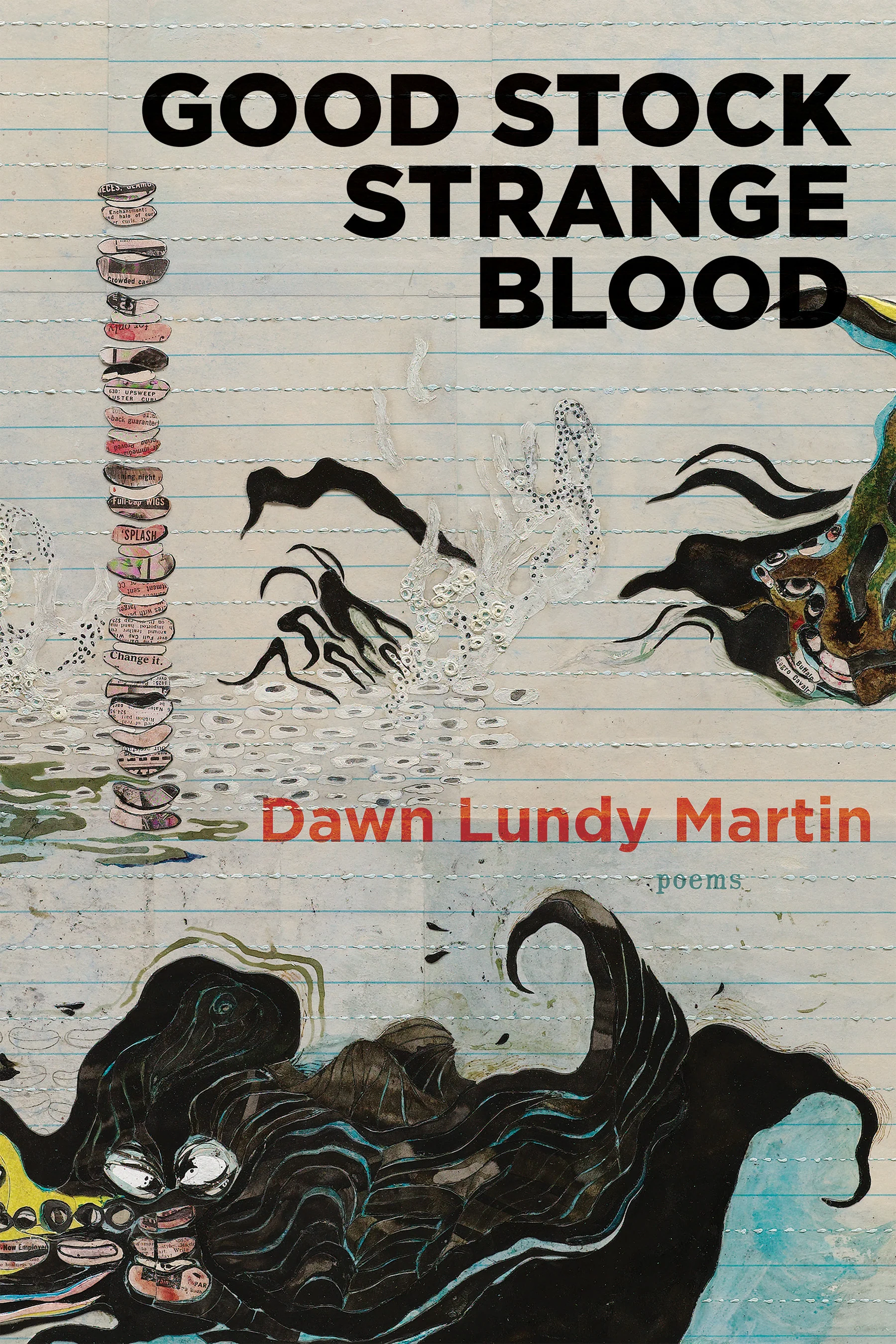
Good Stock Strange Blood
Poetry by Dawn Lundy Martin
August 1, 2017 • 6 x 9 • 144 Pages • 978-1-56689-471-5
Bold, formally innovative prose poems that challenge our ideas of race, voice, bodies, and justice.
From Good Stock Strange Blood:
“And, yet, each morning a fireheart grief in the body coming out of sleep. The listening to the smoke as if fills and weeps inside the chest, choking strength out hands weighted, dangling. We wonder where else it lives before it fills the body up. We assume it comes inside through the hole that promises invasion.”
About the Author
Dawn Lundy Martin is the author of A Gathering of Matter / A Matter of Gathering (University of Georgia Press, 2007), Discipline (Nightboat Books, 2011), and Life in a Box is a Pretty Life (Nightboat Books, 2015). Martin is also a cofounder of the Black Took Collective and a member of the HOWDOYOUSAYYAMINAFRICAN? global arts collective. She is associate professor of English at the University of Pittsburgh.
Thanks to a 2013 ADA Access Improvement Grant administered by VSA Minnesota for the Metropolitan Regional Arts Council, this title is also formatted for screen readers which make text accessible to the blind and visually impaired. To purchase this title for use with a screen reader please call (612) 338-0125 or email us at info@coffeehousepress.org.
Reviews
Winner of the 2019 Kingsley Tufts Poetry Award
Finalist for the Lambda Literary Award in Lesbian Poetry
“In her latest collection, Martin contemplates the corporeal aspects of black identity, including scars from historical traumas and pain from fresher wounds. . . . In this esoteric and ruminative work, God is shown to be present in the midst of a host of desires and griefs both great and small.” —Publishers Weekly
“Martin uses a whiplash of short, punched-at-us phrases that offer a powerful sense of African American history and the struggle to define oneself for oneself, not as others would . . . An important work for sophisticated readers.” —Library Journal
“Martin charts new possibilities for subverting those (white) structures of domination and control that would reduce black subjectivity to a mute and endless re-inscription of its traumatized collective past.” —Poetry Northwest
“Through a variety of poetic and visual forms . . . this challenging collection exposes the vulnerability of the black body.” —Little Infinite newsletter
“What this book wants, writes Dawn Lundy Martin, is to know ‘the distance between the “I” and the “you.”’ And to try to know this distance we are taken through the catastrophe of what it means to have a body: a body that is assigned its identity, a body that is assigned its history, a body in constant resistance to that which we are called and to that which we call ourselves, and to that which we understand about ourselves, and to that which we have no words for. I read Good Stock Strange Blood and then I read it again immediately because I needed to relive the relentless and beautiful pressure placed on every word, every page, every silence. A relentless pressure placed on the body that is fetishized, shackled, split, strangled, beaten, hated, compressed, trashed, drowned, measured, mirrored, dragged, discarded, disappeared, opened, punctured, displayed, encased. The question of ‘what allows the body to survive’ is at the heart of Good Stock Strange Blood, and it has been at the heart of Lundy Martin’s previous books as well (Discipline, Life in a Box is a Pretty Life). But if there’s a continuation of interrogations, then it must also be said that in Good Stock Strange Blood there is a more mesmerizing intensity. And if there’s an answer in this book to the question of what allows a body to survive, then perhaps it has to do with how we confront and give words and breath and sound and silence to a life of meticulously drawn images that are ghostly, brutal, and vivifying.” —Daniel Borzutzky
“Every time I read Good Stock Strange Blood, a new, deepened book awaits me. Which is to say, it’s got trap doors, trick sleeves; it takes swerves, detours, and dives. Dawn Lundy Martin’s poems read like a real-time excavation of what poetry can and can’t do; how the past is never past; how to stand in the blur, the ‘griefmouth’ of personal and collective pain and somehow—against all odds—make thought, make fury, make song. We need this resilience, this bloody reckoning, this wit and nuance, now.” —Maggie Nelson, author of The Red Parts
“‘What is life against the quantifying of power? The partitioning of dearth?’ I read Good Stock Strange Blood with the echo of Albert Woodfox’s recent words in my head (‘How do you want me to know how it feels to be free?’). Martin’s tender and defiant gesture in these unshakable poems is to open and open, relentlessly, into rage and desire, into blackness and ‘blackness’ (‘the “black bits” will be excisable, quotable in reviews’), into an AfroFuture where ‘existence inside of both loss and abundance’ might no longer feel impossible: ‘No death. But, instead, the door.’ There is a project here, one that acknowledges and confronts the ‘failure of images,’ the constraints of the book, the limitations of the reader—‘[t]o excise life from the relations of power.’ I want everyone I know to read this book.” —Anna Moschovakis
“Dawn Lundy Martin is a young essential voice in American poetry—one many of us have been waiting for.” —Diesel Bookstore Oakland
“Martin purposely challenges with tangential images and fractured lines to look inward at racial and personal trauma.” —Pittsburgh City Paper
“Good Stock Strange Blood is a subtle and intriguing meditation, original in form, experimental in theme, and curious and probing in content.” —NewPages
“Dawn Lundy Martin’s poetry is eviscerated and eviscerating. In Good Stock Strange Blood, she languages violence and the varied textures and hues of systemic racism and intergenerational trauma while creating a new state of being, simultaneously cauterized and free.” —Full Stop
Poetry by Dawn Lundy Martin
August 1, 2017 • 6 x 9 • 144 Pages • 978-1-56689-471-5
Bold, formally innovative prose poems that challenge our ideas of race, voice, bodies, and justice.
From Good Stock Strange Blood:
“And, yet, each morning a fireheart grief in the body coming out of sleep. The listening to the smoke as if fills and weeps inside the chest, choking strength out hands weighted, dangling. We wonder where else it lives before it fills the body up. We assume it comes inside through the hole that promises invasion.”
About the Author
Dawn Lundy Martin is the author of A Gathering of Matter / A Matter of Gathering (University of Georgia Press, 2007), Discipline (Nightboat Books, 2011), and Life in a Box is a Pretty Life (Nightboat Books, 2015). Martin is also a cofounder of the Black Took Collective and a member of the HOWDOYOUSAYYAMINAFRICAN? global arts collective. She is associate professor of English at the University of Pittsburgh.
Thanks to a 2013 ADA Access Improvement Grant administered by VSA Minnesota for the Metropolitan Regional Arts Council, this title is also formatted for screen readers which make text accessible to the blind and visually impaired. To purchase this title for use with a screen reader please call (612) 338-0125 or email us at info@coffeehousepress.org.
Reviews
Winner of the 2019 Kingsley Tufts Poetry Award
Finalist for the Lambda Literary Award in Lesbian Poetry
“In her latest collection, Martin contemplates the corporeal aspects of black identity, including scars from historical traumas and pain from fresher wounds. . . . In this esoteric and ruminative work, God is shown to be present in the midst of a host of desires and griefs both great and small.” —Publishers Weekly
“Martin uses a whiplash of short, punched-at-us phrases that offer a powerful sense of African American history and the struggle to define oneself for oneself, not as others would . . . An important work for sophisticated readers.” —Library Journal
“Martin charts new possibilities for subverting those (white) structures of domination and control that would reduce black subjectivity to a mute and endless re-inscription of its traumatized collective past.” —Poetry Northwest
“Through a variety of poetic and visual forms . . . this challenging collection exposes the vulnerability of the black body.” —Little Infinite newsletter
“What this book wants, writes Dawn Lundy Martin, is to know ‘the distance between the “I” and the “you.”’ And to try to know this distance we are taken through the catastrophe of what it means to have a body: a body that is assigned its identity, a body that is assigned its history, a body in constant resistance to that which we are called and to that which we call ourselves, and to that which we understand about ourselves, and to that which we have no words for. I read Good Stock Strange Blood and then I read it again immediately because I needed to relive the relentless and beautiful pressure placed on every word, every page, every silence. A relentless pressure placed on the body that is fetishized, shackled, split, strangled, beaten, hated, compressed, trashed, drowned, measured, mirrored, dragged, discarded, disappeared, opened, punctured, displayed, encased. The question of ‘what allows the body to survive’ is at the heart of Good Stock Strange Blood, and it has been at the heart of Lundy Martin’s previous books as well (Discipline, Life in a Box is a Pretty Life). But if there’s a continuation of interrogations, then it must also be said that in Good Stock Strange Blood there is a more mesmerizing intensity. And if there’s an answer in this book to the question of what allows a body to survive, then perhaps it has to do with how we confront and give words and breath and sound and silence to a life of meticulously drawn images that are ghostly, brutal, and vivifying.” —Daniel Borzutzky
“Every time I read Good Stock Strange Blood, a new, deepened book awaits me. Which is to say, it’s got trap doors, trick sleeves; it takes swerves, detours, and dives. Dawn Lundy Martin’s poems read like a real-time excavation of what poetry can and can’t do; how the past is never past; how to stand in the blur, the ‘griefmouth’ of personal and collective pain and somehow—against all odds—make thought, make fury, make song. We need this resilience, this bloody reckoning, this wit and nuance, now.” —Maggie Nelson, author of The Red Parts
“‘What is life against the quantifying of power? The partitioning of dearth?’ I read Good Stock Strange Blood with the echo of Albert Woodfox’s recent words in my head (‘How do you want me to know how it feels to be free?’). Martin’s tender and defiant gesture in these unshakable poems is to open and open, relentlessly, into rage and desire, into blackness and ‘blackness’ (‘the “black bits” will be excisable, quotable in reviews’), into an AfroFuture where ‘existence inside of both loss and abundance’ might no longer feel impossible: ‘No death. But, instead, the door.’ There is a project here, one that acknowledges and confronts the ‘failure of images,’ the constraints of the book, the limitations of the reader—‘[t]o excise life from the relations of power.’ I want everyone I know to read this book.” —Anna Moschovakis
“Dawn Lundy Martin is a young essential voice in American poetry—one many of us have been waiting for.” —Diesel Bookstore Oakland
“Martin purposely challenges with tangential images and fractured lines to look inward at racial and personal trauma.” —Pittsburgh City Paper
“Good Stock Strange Blood is a subtle and intriguing meditation, original in form, experimental in theme, and curious and probing in content.” —NewPages
“Dawn Lundy Martin’s poetry is eviscerated and eviscerating. In Good Stock Strange Blood, she languages violence and the varied textures and hues of systemic racism and intergenerational trauma while creating a new state of being, simultaneously cauterized and free.” —Full Stop
Original: $16.95
-70%$16.95
$5.08Description
Poetry by Dawn Lundy Martin
August 1, 2017 • 6 x 9 • 144 Pages • 978-1-56689-471-5
Bold, formally innovative prose poems that challenge our ideas of race, voice, bodies, and justice.
From Good Stock Strange Blood:
“And, yet, each morning a fireheart grief in the body coming out of sleep. The listening to the smoke as if fills and weeps inside the chest, choking strength out hands weighted, dangling. We wonder where else it lives before it fills the body up. We assume it comes inside through the hole that promises invasion.”
About the Author
Dawn Lundy Martin is the author of A Gathering of Matter / A Matter of Gathering (University of Georgia Press, 2007), Discipline (Nightboat Books, 2011), and Life in a Box is a Pretty Life (Nightboat Books, 2015). Martin is also a cofounder of the Black Took Collective and a member of the HOWDOYOUSAYYAMINAFRICAN? global arts collective. She is associate professor of English at the University of Pittsburgh.
Thanks to a 2013 ADA Access Improvement Grant administered by VSA Minnesota for the Metropolitan Regional Arts Council, this title is also formatted for screen readers which make text accessible to the blind and visually impaired. To purchase this title for use with a screen reader please call (612) 338-0125 or email us at info@coffeehousepress.org.
Reviews
Winner of the 2019 Kingsley Tufts Poetry Award
Finalist for the Lambda Literary Award in Lesbian Poetry
“In her latest collection, Martin contemplates the corporeal aspects of black identity, including scars from historical traumas and pain from fresher wounds. . . . In this esoteric and ruminative work, God is shown to be present in the midst of a host of desires and griefs both great and small.” —Publishers Weekly
“Martin uses a whiplash of short, punched-at-us phrases that offer a powerful sense of African American history and the struggle to define oneself for oneself, not as others would . . . An important work for sophisticated readers.” —Library Journal
“Martin charts new possibilities for subverting those (white) structures of domination and control that would reduce black subjectivity to a mute and endless re-inscription of its traumatized collective past.” —Poetry Northwest
“Through a variety of poetic and visual forms . . . this challenging collection exposes the vulnerability of the black body.” —Little Infinite newsletter
“What this book wants, writes Dawn Lundy Martin, is to know ‘the distance between the “I” and the “you.”’ And to try to know this distance we are taken through the catastrophe of what it means to have a body: a body that is assigned its identity, a body that is assigned its history, a body in constant resistance to that which we are called and to that which we call ourselves, and to that which we understand about ourselves, and to that which we have no words for. I read Good Stock Strange Blood and then I read it again immediately because I needed to relive the relentless and beautiful pressure placed on every word, every page, every silence. A relentless pressure placed on the body that is fetishized, shackled, split, strangled, beaten, hated, compressed, trashed, drowned, measured, mirrored, dragged, discarded, disappeared, opened, punctured, displayed, encased. The question of ‘what allows the body to survive’ is at the heart of Good Stock Strange Blood, and it has been at the heart of Lundy Martin’s previous books as well (Discipline, Life in a Box is a Pretty Life). But if there’s a continuation of interrogations, then it must also be said that in Good Stock Strange Blood there is a more mesmerizing intensity. And if there’s an answer in this book to the question of what allows a body to survive, then perhaps it has to do with how we confront and give words and breath and sound and silence to a life of meticulously drawn images that are ghostly, brutal, and vivifying.” —Daniel Borzutzky
“Every time I read Good Stock Strange Blood, a new, deepened book awaits me. Which is to say, it’s got trap doors, trick sleeves; it takes swerves, detours, and dives. Dawn Lundy Martin’s poems read like a real-time excavation of what poetry can and can’t do; how the past is never past; how to stand in the blur, the ‘griefmouth’ of personal and collective pain and somehow—against all odds—make thought, make fury, make song. We need this resilience, this bloody reckoning, this wit and nuance, now.” —Maggie Nelson, author of The Red Parts
“‘What is life against the quantifying of power? The partitioning of dearth?’ I read Good Stock Strange Blood with the echo of Albert Woodfox’s recent words in my head (‘How do you want me to know how it feels to be free?’). Martin’s tender and defiant gesture in these unshakable poems is to open and open, relentlessly, into rage and desire, into blackness and ‘blackness’ (‘the “black bits” will be excisable, quotable in reviews’), into an AfroFuture where ‘existence inside of both loss and abundance’ might no longer feel impossible: ‘No death. But, instead, the door.’ There is a project here, one that acknowledges and confronts the ‘failure of images,’ the constraints of the book, the limitations of the reader—‘[t]o excise life from the relations of power.’ I want everyone I know to read this book.” —Anna Moschovakis
“Dawn Lundy Martin is a young essential voice in American poetry—one many of us have been waiting for.” —Diesel Bookstore Oakland
“Martin purposely challenges with tangential images and fractured lines to look inward at racial and personal trauma.” —Pittsburgh City Paper
“Good Stock Strange Blood is a subtle and intriguing meditation, original in form, experimental in theme, and curious and probing in content.” —NewPages
“Dawn Lundy Martin’s poetry is eviscerated and eviscerating. In Good Stock Strange Blood, she languages violence and the varied textures and hues of systemic racism and intergenerational trauma while creating a new state of being, simultaneously cauterized and free.” —Full Stop