Winner of the 2021 CLMP Firecracker Award for Poetry
Finalist for the 2021 Lambda Literary Award in Gay Poetry
Washington Post, “Best Poetry Collections of 2020”
NPR, “Favorite Books of 2020”
New York Times, “New and Noteworthy”
Buzzfeed, “Most Anticipated Titles of 2020”
Literary Hub, “Most Anticipated Books of 2020”
“Reed blends intersectional politics and bodily hunger in precise, thorny language.” —New York Times
“Reminds us that poetry can be playful and deadly serious in the same moment. . . . [Reed] piles on anxious images and quasi-logical connections to create a gratifying weirdness.” —Troy Jollimore, Washington Post
“In The Malevolent Volume, Justin Phillip Reed offers multiple realities and their consequences. Challenging our thinking, these poems consider the uses of horror: through the page, we experience what it's like to be both haunted and that which haunts. In doing so, Reed doesn't bend genre as much as he extends it with endless possibility.
A dextrous and epic music, this book faces down our combative and trespassed American moment. Almost every line is meant to be repeated slowly and held aloft for its heart-stopping craftsmanship. Studded with so many jeweled lines, we find, not absolution, but a complicated grace that will never, never accept your refusal.
Building, its lyric moves from baroque density to unraveling flight, bespeaking the urgency of our moment, the cruel bluntness of fascism, and its entrenchment in the foundational horror of national belonging, with its accompanying exclusions. ‘Is it like a life,’ this malevolence we endure? Justin Phillip Reed has written a book that beckons us to reread as we seek to understand our time, how much of it is promissory and how much apocalyptic.” —Judges' citation, 2021 Firecracker Award in Poetry
“[M]agnificent. . . . The gorgeous precision of the poems refuse to perform for the white gaze—they snatch back blackness from being used as a trope, crafting instead a new canon.” —Erin Adair-Hodges, St. Louis Post-Dispatch
“Incendiary. With breathtaking lyrical dexterity, Reed first rebukes and then remakes western literature and myth, bringing Black queerness to the forefront. . . . Reed performs a deft sleight-of-hand to embrace the territory of horror and monstrousness—harnessing its inherent power to threaten the status quo.” —Luiza Flynn-Goodlett, Adroit Journal
“How Reed found a way to write a book as fanged and fabulous and complexly musical as this one right after his National Book Award-winning debut, Indecency, is a mystery, but one thing’s clear now: he’s here to stay. These are strong poems, showcasing a range of moods and affects. Sometimes punctuated, otherwise so neatly joined they don’t need it. Sometimes gentle, in other moments, wielding fury’s high bright tone.” —John Freeman, Literary Hub
“A tour-de-force featuring a striking voice and artistry that will dazzle the vision, stun the ear, and demand attention. . . . [Reed] is conducting a literary chemical experiment that brings forward a new element with a long half-life, far past the ending of this collection.” —Mandana Chaffa, Jacket2
“A poetry collection of extraordinary range, chameleonic and sure-handed in its embrace of form, yet without being formalistic or formulaic. . . . Each title suggests the plunge in this poet's quest to torment us with stinging, hard-won compassion and merciless self-exploration, stages as mythos, awaiting the reader who braves the labyrinth. A marvel of construction, it is a good place to get lost.” —Herman Van den Reech, Caesura
“The Malevolent Volume takes us on a trip through a world that is familiar but slightly askew, as if one were walking through a haze or looking into a funhouse mirror. . . . Reed’s poems know perfectly well how to make their reader stop and listen.” —Margaryta Golovchenko, The Town Crier
“I’d quote a few of the breathtaking detonations across this incredible collection if there weren’t so many. On every page the intimacies of mind and body, myth and memory are simultaneously sung and said. It’s not quite enough to salute the literary ties and tangles, the range and urgency of subjects, the layered lyric linguistics. The Malevolent Volume is roundly astounding. Reed is making a new and wholly irreducible line through the waters of American poetry.” —Terrance Hayes
“‘Its trumpets, they will ramify.’ Deliberate in its every movement, this collection is a most satisfying force of will. Justin Phillip Reed’s follow-up, The Malevolent Volume, is a masterpiece to which I will ‘be always arriving.’ If our work as poets is to transform what most would call violence and what beasts accept as natural, this is a blueprint for how to do so ethically and masterfully. Here, in word, is a guttural and gutting music. Every poem becomes a new and necessary etymology of ‘malevolent.’ The beast in me bows to the beast in you, Justin. This is a restorative Black eco-poetics; where afropessimism meets afrofuturism.” —Marwa Helal
“Horror is a genre of encounters not with the unknown, but with what is most familiar—and therefore most unshakeable. If it is a monstrous language that Justin Phillip Reed employs in The Malevolent Volume, it’s a monster you already know well. Reed is a master of many things—meter, momentum, lexical richness, the musculature of syntax, how to haunt an insistently violent canon—but perhaps chief among them is the dark magic of harnessing language’s wilds into something that blooms into a real shout inside you. You must understand: it’s not strangeness you’re seeing here. It is audacity—the audacity of the queer, Black body, the brilliant body, which won’t, and won’t, and won’t die.” —Franny Choi
Praise for Justin Phillip Reed
Winner of the 2018 National Book Award for Poetry
Recipient of a 2019 Ruth Lilly and Dorothy Sargent Rosenberg Fellowship
Winner of the 2019 Lambda Literary Award in Gay Poetry
Finalist for the 2019 Kate Tufts Discovery Award
BCALA 2019 Honor Best Poetry Award winner
Library Journal, “Best Books 2018”
“Boldly and carefully executed and perfectly ragged. In these poems, Justin Phillip Reed experiments with language to explore inequity and injustice and to critique and lament the culture of white supremacy and the dominant social order.” —National Book Foundation
“Reed’s visceral and teasingly cerebral debut probes black identity, sexuality, and violence and is inseparably personal and political. He displays a searing sense of injustice about dehumanizing systems, and his speakers evoke the quotidian with formidable eloquence.” —Publishers Weekly, starred review
“[Reed’s] poems take up the body in desire and violence, and they do so by thrusting the reader into a stark visceral encounter with their material.” —New York Times
“Raw, nervy, reverberant, densely packed language whose import simply can’t be reduced to easy explanation. . . . One-of-a-kind brilliant.” —Library Journal
“Indecency made me stand up and applaud.” —The Millions
“Reed’s poems are formally inventive, especially when he works in concrete ways on the page. . . . The reader winds up in a new place without realizing they were being moved there.” —The Rumpus
“Rich with musical echoes and sonic ironies.” —Vulture
“A poignant, searing book.” —Entertainment Weekly
“Reed’s wit and formal experimentation, quicksilver and luminous, shows the world as it is, while detailing how the very people that society most devalues, demeans, and seeks to destroy are its true visionaries.” —The Adroit Journal
“Reed wrestles with finding the language to convey the pain of that double oppression and still manages to create terrible beauty.” —Signature
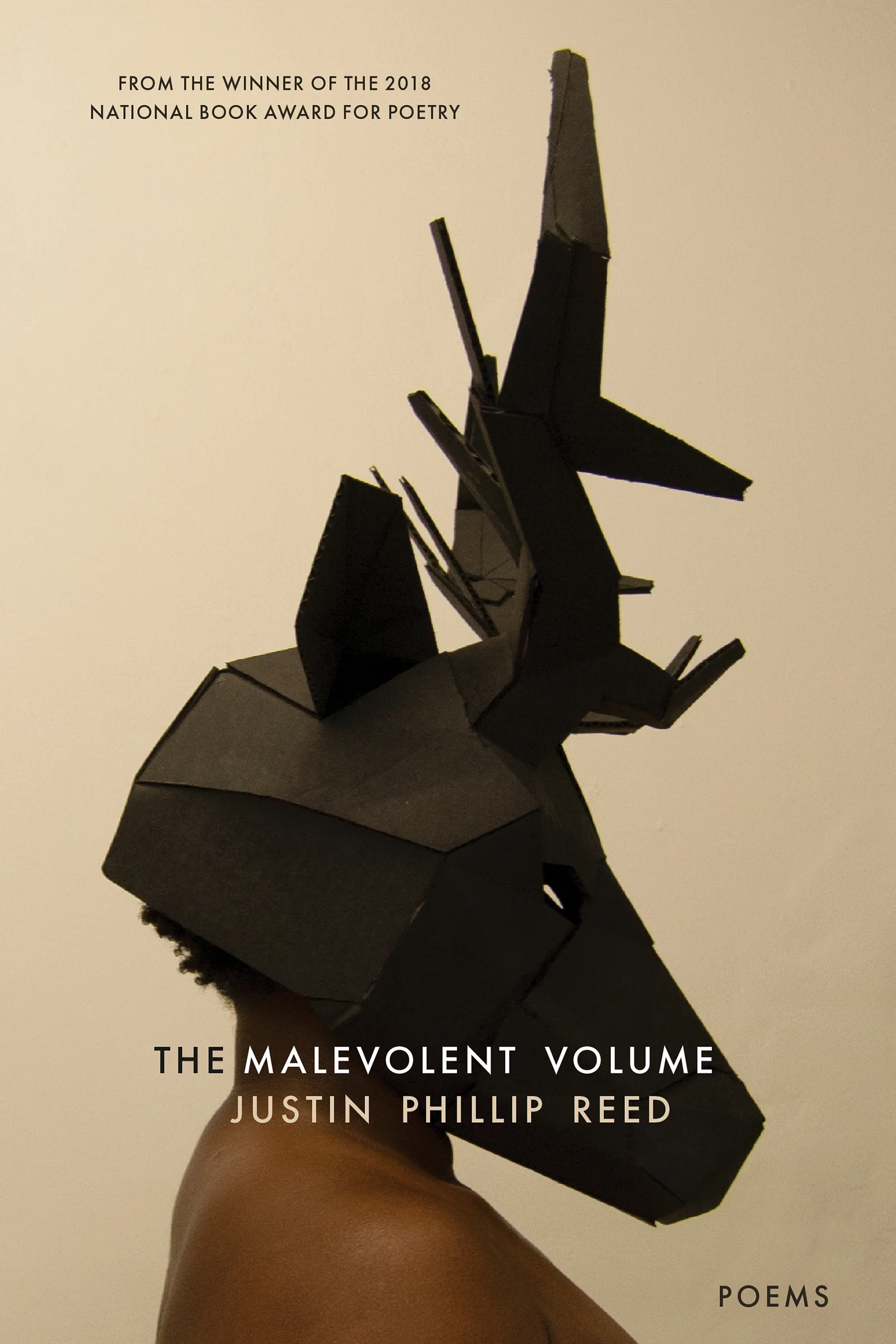
The Malevolent Volume
Poetry by Justin Phillip Reed
April 7, 2020 • 6 x 9 • 104 pages • 978-1-56689-576-7
The Malevolent Volume explores the myths and transformations of Black being, on a continuum between the monstrous and the sublime.
Subverting celebrated classics of poetry and mythology and examining horrors from contemporary film and cultural fact, National Book Award winner Justin Phillip Reed engages darkness as an aesthetic to conjure the revenant animus that lurks beneath the exploited civilities of marginalized people. In these poems, Reed finds agency in the other-than-human identities assigned to those assaulted by savageries of the state. In doing so, he summons a retaliatory, counterviolent Black spirit to revolt and to inhabit the revolting.
About the Author
Justin Phillip Reed is an American poet and essayist. He is the author of Indecency (Coffee House Press), winner of the 2018 National Book Award in Poetry and Lambda Literary Award for Gay Poetry, and a finalist for the 2019 Kate Tufts Discovery Award. He is the 2019-2021 Fellow in Creative Writing at the Center for African American Poetry and Poetics. His work appears in African American Review, Denver Quarterly, Guernica, the New Republic, Obsidian, and elsewhere. He earned his BA in creative writing at Tusculum College and his MFA in poetry at Washington University in St. Louis. He has received fellowships from the Cave Canem Foundation, the Conversation Literary Festival, and the Regional Arts Commission of St. Louis. He was born and raised in South Carolina.
Praise for The Malevolent Volume
Winner of the 2021 CLMP Firecracker Award for Poetry
Finalist for the 2021 Lambda Literary Award in Gay Poetry
Washington Post, “Best Poetry Collections of 2020”
NPR, “Favorite Books of 2020”
New York Times, “New and Noteworthy”
Buzzfeed, “Most Anticipated Titles of 2020”
Literary Hub, “Most Anticipated Books of 2020”
“Reed blends intersectional politics and bodily hunger in precise, thorny language.” —New York Times
“Reminds us that poetry can be playful and deadly serious in the same moment. . . . [Reed] piles on anxious images and quasi-logical connections to create a gratifying weirdness.” —Troy Jollimore, Washington Post
“In The Malevolent Volume, Justin Phillip Reed offers multiple realities and their consequences. Challenging our thinking, these poems consider the uses of horror: through the page, we experience what it's like to be both haunted and that which haunts. In doing so, Reed doesn't bend genre as much as he extends it with endless possibility.
A dextrous and epic music, this book faces down our combative and trespassed American moment. Almost every line is meant to be repeated slowly and held aloft for its heart-stopping craftsmanship. Studded with so many jeweled lines, we find, not absolution, but a complicated grace that will never, never accept your refusal.
Building, its lyric moves from baroque density to unraveling flight, bespeaking the urgency of our moment, the cruel bluntness of fascism, and its entrenchment in the foundational horror of national belonging, with its accompanying exclusions. ‘Is it like a life,’ this malevolence we endure? Justin Phillip Reed has written a book that beckons us to reread as we seek to understand our time, how much of it is promissory and how much apocalyptic.” —Judges' citation, 2021 Firecracker Award in Poetry
“[M]agnificent. . . . The gorgeous precision of the poems refuse to perform for the white gaze—they snatch back blackness from being used as a trope, crafting instead a new canon.” —Erin Adair-Hodges, St. Louis Post-Dispatch
“Incendiary. With breathtaking lyrical dexterity, Reed first rebukes and then remakes western literature and myth, bringing Black queerness to the forefront. . . . Reed performs a deft sleight-of-hand to embrace the territory of horror and monstrousness—harnessing its inherent power to threaten the status quo.” —Luiza Flynn-Goodlett, Adroit Journal
“How Reed found a way to write a book as fanged and fabulous and complexly musical as this one right after his National Book Award-winning debut, Indecency, is a mystery, but one thing’s clear now: he’s here to stay. These are strong poems, showcasing a range of moods and affects. Sometimes punctuated, otherwise so neatly joined they don’t need it. Sometimes gentle, in other moments, wielding fury’s high bright tone.” —John Freeman, Literary Hub
“A tour-de-force featuring a striking voice and artistry that will dazzle the vision, stun the ear, and demand attention. . . . [Reed] is conducting a literary chemical experiment that brings forward a new element with a long half-life, far past the ending of this collection.” —Mandana Chaffa, Jacket2
“A poetry collection of extraordinary range, chameleonic and sure-handed in its embrace of form, yet without being formalistic or formulaic. . . . Each title suggests the plunge in this poet's quest to torment us with stinging, hard-won compassion and merciless self-exploration, stages as mythos, awaiting the reader who braves the labyrinth. A marvel of construction, it is a good place to get lost.” —Herman Van den Reech, Caesura
“The Malevolent Volume takes us on a trip through a world that is familiar but slightly askew, as if one were walking through a haze or looking into a funhouse mirror. . . . Reed’s poems know perfectly well how to make their reader stop and listen.” —Margaryta Golovchenko, The Town Crier
“I’d quote a few of the breathtaking detonations across this incredible collection if there weren’t so many. On every page the intimacies of mind and body, myth and memory are simultaneously sung and said. It’s not quite enough to salute the literary ties and tangles, the range and urgency of subjects, the layered lyric linguistics. The Malevolent Volume is roundly astounding. Reed is making a new and wholly irreducible line through the waters of American poetry.” —Terrance Hayes
“‘Its trumpets, they will ramify.’ Deliberate in its every movement, this collection is a most satisfying force of will. Justin Phillip Reed’s follow-up, The Malevolent Volume, is a masterpiece to which I will ‘be always arriving.’ If our work as poets is to transform what most would call violence and what beasts accept as natural, this is a blueprint for how to do so ethically and masterfully. Here, in word, is a guttural and gutting music. Every poem becomes a new and necessary etymology of ‘malevolent.’ The beast in me bows to the beast in you, Justin. This is a restorative Black eco-poetics; where afropessimism meets afrofuturism.” —Marwa Helal
“Horror is a genre of encounters not with the unknown, but with what is most familiar—and therefore most unshakeable. If it is a monstrous language that Justin Phillip Reed employs in The Malevolent Volume, it’s a monster you already know well. Reed is a master of many things—meter, momentum, lexical richness, the musculature of syntax, how to haunt an insistently violent canon—but perhaps chief among them is the dark magic of harnessing language’s wilds into something that blooms into a real shout inside you. You must understand: it’s not strangeness you’re seeing here. It is audacity—the audacity of the queer, Black body, the brilliant body, which won’t, and won’t, and won’t die.” —Franny Choi
Praise for Justin Phillip Reed
Winner of the 2018 National Book Award for Poetry
Recipient of a 2019 Ruth Lilly and Dorothy Sargent Rosenberg Fellowship
Winner of the 2019 Lambda Literary Award in Gay Poetry
Finalist for the 2019 Kate Tufts Discovery Award
BCALA 2019 Honor Best Poetry Award winner
Library Journal, “Best Books 2018”
“Boldly and carefully executed and perfectly ragged. In these poems, Justin Phillip Reed experiments with language to explore inequity and injustice and to critique and lament the culture of white supremacy and the dominant social order.” —National Book Foundation
“Reed’s visceral and teasingly cerebral debut probes black identity, sexuality, and violence and is inseparably personal and political. He displays a searing sense of injustice about dehumanizing systems, and his speakers evoke the quotidian with formidable eloquence.” —Publishers Weekly, starred review
“[Reed’s] poems take up the body in desire and violence, and they do so by thrusting the reader into a stark visceral encounter with their material.” —New York Times
“Raw, nervy, reverberant, densely packed language whose import simply can’t be reduced to easy explanation. . . . One-of-a-kind brilliant.” —Library Journal
“Indecency made me stand up and applaud.” —The Millions
“Reed’s poems are formally inventive, especially when he works in concrete ways on the page. . . . The reader winds up in a new place without realizing they were being moved there.” —The Rumpus
“Rich with musical echoes and sonic ironies.” —Vulture
“A poignant, searing book.” —Entertainment Weekly
“Reed’s wit and formal experimentation, quicksilver and luminous, shows the world as it is, while detailing how the very people that society most devalues, demeans, and seeks to destroy are its true visionaries.” —The Adroit Journal
“Reed wrestles with finding the language to convey the pain of that double oppression and still manages to create terrible beauty.” —Signature
Poetry by Justin Phillip Reed
April 7, 2020 • 6 x 9 • 104 pages • 978-1-56689-576-7
The Malevolent Volume explores the myths and transformations of Black being, on a continuum between the monstrous and the sublime.
Subverting celebrated classics of poetry and mythology and examining horrors from contemporary film and cultural fact, National Book Award winner Justin Phillip Reed engages darkness as an aesthetic to conjure the revenant animus that lurks beneath the exploited civilities of marginalized people. In these poems, Reed finds agency in the other-than-human identities assigned to those assaulted by savageries of the state. In doing so, he summons a retaliatory, counterviolent Black spirit to revolt and to inhabit the revolting.
About the Author
Justin Phillip Reed is an American poet and essayist. He is the author of Indecency (Coffee House Press), winner of the 2018 National Book Award in Poetry and Lambda Literary Award for Gay Poetry, and a finalist for the 2019 Kate Tufts Discovery Award. He is the 2019-2021 Fellow in Creative Writing at the Center for African American Poetry and Poetics. His work appears in African American Review, Denver Quarterly, Guernica, the New Republic, Obsidian, and elsewhere. He earned his BA in creative writing at Tusculum College and his MFA in poetry at Washington University in St. Louis. He has received fellowships from the Cave Canem Foundation, the Conversation Literary Festival, and the Regional Arts Commission of St. Louis. He was born and raised in South Carolina.
Praise for The Malevolent Volume
Winner of the 2021 CLMP Firecracker Award for Poetry
Finalist for the 2021 Lambda Literary Award in Gay Poetry
Washington Post, “Best Poetry Collections of 2020”
NPR, “Favorite Books of 2020”
New York Times, “New and Noteworthy”
Buzzfeed, “Most Anticipated Titles of 2020”
Literary Hub, “Most Anticipated Books of 2020”
“Reed blends intersectional politics and bodily hunger in precise, thorny language.” —New York Times
“Reminds us that poetry can be playful and deadly serious in the same moment. . . . [Reed] piles on anxious images and quasi-logical connections to create a gratifying weirdness.” —Troy Jollimore, Washington Post
“In The Malevolent Volume, Justin Phillip Reed offers multiple realities and their consequences. Challenging our thinking, these poems consider the uses of horror: through the page, we experience what it's like to be both haunted and that which haunts. In doing so, Reed doesn't bend genre as much as he extends it with endless possibility.
A dextrous and epic music, this book faces down our combative and trespassed American moment. Almost every line is meant to be repeated slowly and held aloft for its heart-stopping craftsmanship. Studded with so many jeweled lines, we find, not absolution, but a complicated grace that will never, never accept your refusal.
Building, its lyric moves from baroque density to unraveling flight, bespeaking the urgency of our moment, the cruel bluntness of fascism, and its entrenchment in the foundational horror of national belonging, with its accompanying exclusions. ‘Is it like a life,’ this malevolence we endure? Justin Phillip Reed has written a book that beckons us to reread as we seek to understand our time, how much of it is promissory and how much apocalyptic.” —Judges' citation, 2021 Firecracker Award in Poetry
“[M]agnificent. . . . The gorgeous precision of the poems refuse to perform for the white gaze—they snatch back blackness from being used as a trope, crafting instead a new canon.” —Erin Adair-Hodges, St. Louis Post-Dispatch
“Incendiary. With breathtaking lyrical dexterity, Reed first rebukes and then remakes western literature and myth, bringing Black queerness to the forefront. . . . Reed performs a deft sleight-of-hand to embrace the territory of horror and monstrousness—harnessing its inherent power to threaten the status quo.” —Luiza Flynn-Goodlett, Adroit Journal
“How Reed found a way to write a book as fanged and fabulous and complexly musical as this one right after his National Book Award-winning debut, Indecency, is a mystery, but one thing’s clear now: he’s here to stay. These are strong poems, showcasing a range of moods and affects. Sometimes punctuated, otherwise so neatly joined they don’t need it. Sometimes gentle, in other moments, wielding fury’s high bright tone.” —John Freeman, Literary Hub
“A tour-de-force featuring a striking voice and artistry that will dazzle the vision, stun the ear, and demand attention. . . . [Reed] is conducting a literary chemical experiment that brings forward a new element with a long half-life, far past the ending of this collection.” —Mandana Chaffa, Jacket2
“A poetry collection of extraordinary range, chameleonic and sure-handed in its embrace of form, yet without being formalistic or formulaic. . . . Each title suggests the plunge in this poet's quest to torment us with stinging, hard-won compassion and merciless self-exploration, stages as mythos, awaiting the reader who braves the labyrinth. A marvel of construction, it is a good place to get lost.” —Herman Van den Reech, Caesura
“The Malevolent Volume takes us on a trip through a world that is familiar but slightly askew, as if one were walking through a haze or looking into a funhouse mirror. . . . Reed’s poems know perfectly well how to make their reader stop and listen.” —Margaryta Golovchenko, The Town Crier
“I’d quote a few of the breathtaking detonations across this incredible collection if there weren’t so many. On every page the intimacies of mind and body, myth and memory are simultaneously sung and said. It’s not quite enough to salute the literary ties and tangles, the range and urgency of subjects, the layered lyric linguistics. The Malevolent Volume is roundly astounding. Reed is making a new and wholly irreducible line through the waters of American poetry.” —Terrance Hayes
“‘Its trumpets, they will ramify.’ Deliberate in its every movement, this collection is a most satisfying force of will. Justin Phillip Reed’s follow-up, The Malevolent Volume, is a masterpiece to which I will ‘be always arriving.’ If our work as poets is to transform what most would call violence and what beasts accept as natural, this is a blueprint for how to do so ethically and masterfully. Here, in word, is a guttural and gutting music. Every poem becomes a new and necessary etymology of ‘malevolent.’ The beast in me bows to the beast in you, Justin. This is a restorative Black eco-poetics; where afropessimism meets afrofuturism.” —Marwa Helal
“Horror is a genre of encounters not with the unknown, but with what is most familiar—and therefore most unshakeable. If it is a monstrous language that Justin Phillip Reed employs in The Malevolent Volume, it’s a monster you already know well. Reed is a master of many things—meter, momentum, lexical richness, the musculature of syntax, how to haunt an insistently violent canon—but perhaps chief among them is the dark magic of harnessing language’s wilds into something that blooms into a real shout inside you. You must understand: it’s not strangeness you’re seeing here. It is audacity—the audacity of the queer, Black body, the brilliant body, which won’t, and won’t, and won’t die.” —Franny Choi
Praise for Justin Phillip Reed
Winner of the 2018 National Book Award for Poetry
Recipient of a 2019 Ruth Lilly and Dorothy Sargent Rosenberg Fellowship
Winner of the 2019 Lambda Literary Award in Gay Poetry
Finalist for the 2019 Kate Tufts Discovery Award
BCALA 2019 Honor Best Poetry Award winner
Library Journal, “Best Books 2018”
“Boldly and carefully executed and perfectly ragged. In these poems, Justin Phillip Reed experiments with language to explore inequity and injustice and to critique and lament the culture of white supremacy and the dominant social order.” —National Book Foundation
“Reed’s visceral and teasingly cerebral debut probes black identity, sexuality, and violence and is inseparably personal and political. He displays a searing sense of injustice about dehumanizing systems, and his speakers evoke the quotidian with formidable eloquence.” —Publishers Weekly, starred review
“[Reed’s] poems take up the body in desire and violence, and they do so by thrusting the reader into a stark visceral encounter with their material.” —New York Times
“Raw, nervy, reverberant, densely packed language whose import simply can’t be reduced to easy explanation. . . . One-of-a-kind brilliant.” —Library Journal
“Indecency made me stand up and applaud.” —The Millions
“Reed’s poems are formally inventive, especially when he works in concrete ways on the page. . . . The reader winds up in a new place without realizing they were being moved there.” —The Rumpus
“Rich with musical echoes and sonic ironies.” —Vulture
“A poignant, searing book.” —Entertainment Weekly
“Reed’s wit and formal experimentation, quicksilver and luminous, shows the world as it is, while detailing how the very people that society most devalues, demeans, and seeks to destroy are its true visionaries.” —The Adroit Journal
“Reed wrestles with finding the language to convey the pain of that double oppression and still manages to create terrible beauty.” —Signature
Original: $16.95
-70%$16.95
$5.08Description
Poetry by Justin Phillip Reed
April 7, 2020 • 6 x 9 • 104 pages • 978-1-56689-576-7
The Malevolent Volume explores the myths and transformations of Black being, on a continuum between the monstrous and the sublime.
Subverting celebrated classics of poetry and mythology and examining horrors from contemporary film and cultural fact, National Book Award winner Justin Phillip Reed engages darkness as an aesthetic to conjure the revenant animus that lurks beneath the exploited civilities of marginalized people. In these poems, Reed finds agency in the other-than-human identities assigned to those assaulted by savageries of the state. In doing so, he summons a retaliatory, counterviolent Black spirit to revolt and to inhabit the revolting.
About the Author
Justin Phillip Reed is an American poet and essayist. He is the author of Indecency (Coffee House Press), winner of the 2018 National Book Award in Poetry and Lambda Literary Award for Gay Poetry, and a finalist for the 2019 Kate Tufts Discovery Award. He is the 2019-2021 Fellow in Creative Writing at the Center for African American Poetry and Poetics. His work appears in African American Review, Denver Quarterly, Guernica, the New Republic, Obsidian, and elsewhere. He earned his BA in creative writing at Tusculum College and his MFA in poetry at Washington University in St. Louis. He has received fellowships from the Cave Canem Foundation, the Conversation Literary Festival, and the Regional Arts Commission of St. Louis. He was born and raised in South Carolina.
Praise for The Malevolent Volume
Winner of the 2021 CLMP Firecracker Award for Poetry
Finalist for the 2021 Lambda Literary Award in Gay Poetry
Washington Post, “Best Poetry Collections of 2020”
NPR, “Favorite Books of 2020”
New York Times, “New and Noteworthy”
Buzzfeed, “Most Anticipated Titles of 2020”
Literary Hub, “Most Anticipated Books of 2020”
“Reed blends intersectional politics and bodily hunger in precise, thorny language.” —New York Times
“Reminds us that poetry can be playful and deadly serious in the same moment. . . . [Reed] piles on anxious images and quasi-logical connections to create a gratifying weirdness.” —Troy Jollimore, Washington Post
“In The Malevolent Volume, Justin Phillip Reed offers multiple realities and their consequences. Challenging our thinking, these poems consider the uses of horror: through the page, we experience what it's like to be both haunted and that which haunts. In doing so, Reed doesn't bend genre as much as he extends it with endless possibility.
A dextrous and epic music, this book faces down our combative and trespassed American moment. Almost every line is meant to be repeated slowly and held aloft for its heart-stopping craftsmanship. Studded with so many jeweled lines, we find, not absolution, but a complicated grace that will never, never accept your refusal.
Building, its lyric moves from baroque density to unraveling flight, bespeaking the urgency of our moment, the cruel bluntness of fascism, and its entrenchment in the foundational horror of national belonging, with its accompanying exclusions. ‘Is it like a life,’ this malevolence we endure? Justin Phillip Reed has written a book that beckons us to reread as we seek to understand our time, how much of it is promissory and how much apocalyptic.” —Judges' citation, 2021 Firecracker Award in Poetry
“[M]agnificent. . . . The gorgeous precision of the poems refuse to perform for the white gaze—they snatch back blackness from being used as a trope, crafting instead a new canon.” —Erin Adair-Hodges, St. Louis Post-Dispatch
“Incendiary. With breathtaking lyrical dexterity, Reed first rebukes and then remakes western literature and myth, bringing Black queerness to the forefront. . . . Reed performs a deft sleight-of-hand to embrace the territory of horror and monstrousness—harnessing its inherent power to threaten the status quo.” —Luiza Flynn-Goodlett, Adroit Journal
“How Reed found a way to write a book as fanged and fabulous and complexly musical as this one right after his National Book Award-winning debut, Indecency, is a mystery, but one thing’s clear now: he’s here to stay. These are strong poems, showcasing a range of moods and affects. Sometimes punctuated, otherwise so neatly joined they don’t need it. Sometimes gentle, in other moments, wielding fury’s high bright tone.” —John Freeman, Literary Hub
“A tour-de-force featuring a striking voice and artistry that will dazzle the vision, stun the ear, and demand attention. . . . [Reed] is conducting a literary chemical experiment that brings forward a new element with a long half-life, far past the ending of this collection.” —Mandana Chaffa, Jacket2
“A poetry collection of extraordinary range, chameleonic and sure-handed in its embrace of form, yet without being formalistic or formulaic. . . . Each title suggests the plunge in this poet's quest to torment us with stinging, hard-won compassion and merciless self-exploration, stages as mythos, awaiting the reader who braves the labyrinth. A marvel of construction, it is a good place to get lost.” —Herman Van den Reech, Caesura
“The Malevolent Volume takes us on a trip through a world that is familiar but slightly askew, as if one were walking through a haze or looking into a funhouse mirror. . . . Reed’s poems know perfectly well how to make their reader stop and listen.” —Margaryta Golovchenko, The Town Crier
“I’d quote a few of the breathtaking detonations across this incredible collection if there weren’t so many. On every page the intimacies of mind and body, myth and memory are simultaneously sung and said. It’s not quite enough to salute the literary ties and tangles, the range and urgency of subjects, the layered lyric linguistics. The Malevolent Volume is roundly astounding. Reed is making a new and wholly irreducible line through the waters of American poetry.” —Terrance Hayes
“‘Its trumpets, they will ramify.’ Deliberate in its every movement, this collection is a most satisfying force of will. Justin Phillip Reed’s follow-up, The Malevolent Volume, is a masterpiece to which I will ‘be always arriving.’ If our work as poets is to transform what most would call violence and what beasts accept as natural, this is a blueprint for how to do so ethically and masterfully. Here, in word, is a guttural and gutting music. Every poem becomes a new and necessary etymology of ‘malevolent.’ The beast in me bows to the beast in you, Justin. This is a restorative Black eco-poetics; where afropessimism meets afrofuturism.” —Marwa Helal
“Horror is a genre of encounters not with the unknown, but with what is most familiar—and therefore most unshakeable. If it is a monstrous language that Justin Phillip Reed employs in The Malevolent Volume, it’s a monster you already know well. Reed is a master of many things—meter, momentum, lexical richness, the musculature of syntax, how to haunt an insistently violent canon—but perhaps chief among them is the dark magic of harnessing language’s wilds into something that blooms into a real shout inside you. You must understand: it’s not strangeness you’re seeing here. It is audacity—the audacity of the queer, Black body, the brilliant body, which won’t, and won’t, and won’t die.” —Franny Choi
Praise for Justin Phillip Reed
Winner of the 2018 National Book Award for Poetry
Recipient of a 2019 Ruth Lilly and Dorothy Sargent Rosenberg Fellowship
Winner of the 2019 Lambda Literary Award in Gay Poetry
Finalist for the 2019 Kate Tufts Discovery Award
BCALA 2019 Honor Best Poetry Award winner
Library Journal, “Best Books 2018”
“Boldly and carefully executed and perfectly ragged. In these poems, Justin Phillip Reed experiments with language to explore inequity and injustice and to critique and lament the culture of white supremacy and the dominant social order.” —National Book Foundation
“Reed’s visceral and teasingly cerebral debut probes black identity, sexuality, and violence and is inseparably personal and political. He displays a searing sense of injustice about dehumanizing systems, and his speakers evoke the quotidian with formidable eloquence.” —Publishers Weekly, starred review
“[Reed’s] poems take up the body in desire and violence, and they do so by thrusting the reader into a stark visceral encounter with their material.” —New York Times
“Raw, nervy, reverberant, densely packed language whose import simply can’t be reduced to easy explanation. . . . One-of-a-kind brilliant.” —Library Journal
“Indecency made me stand up and applaud.” —The Millions
“Reed’s poems are formally inventive, especially when he works in concrete ways on the page. . . . The reader winds up in a new place without realizing they were being moved there.” —The Rumpus
“Rich with musical echoes and sonic ironies.” —Vulture
“A poignant, searing book.” —Entertainment Weekly
“Reed’s wit and formal experimentation, quicksilver and luminous, shows the world as it is, while detailing how the very people that society most devalues, demeans, and seeks to destroy are its true visionaries.” —The Adroit Journal
“Reed wrestles with finding the language to convey the pain of that double oppression and still manages to create terrible beauty.” —Signature